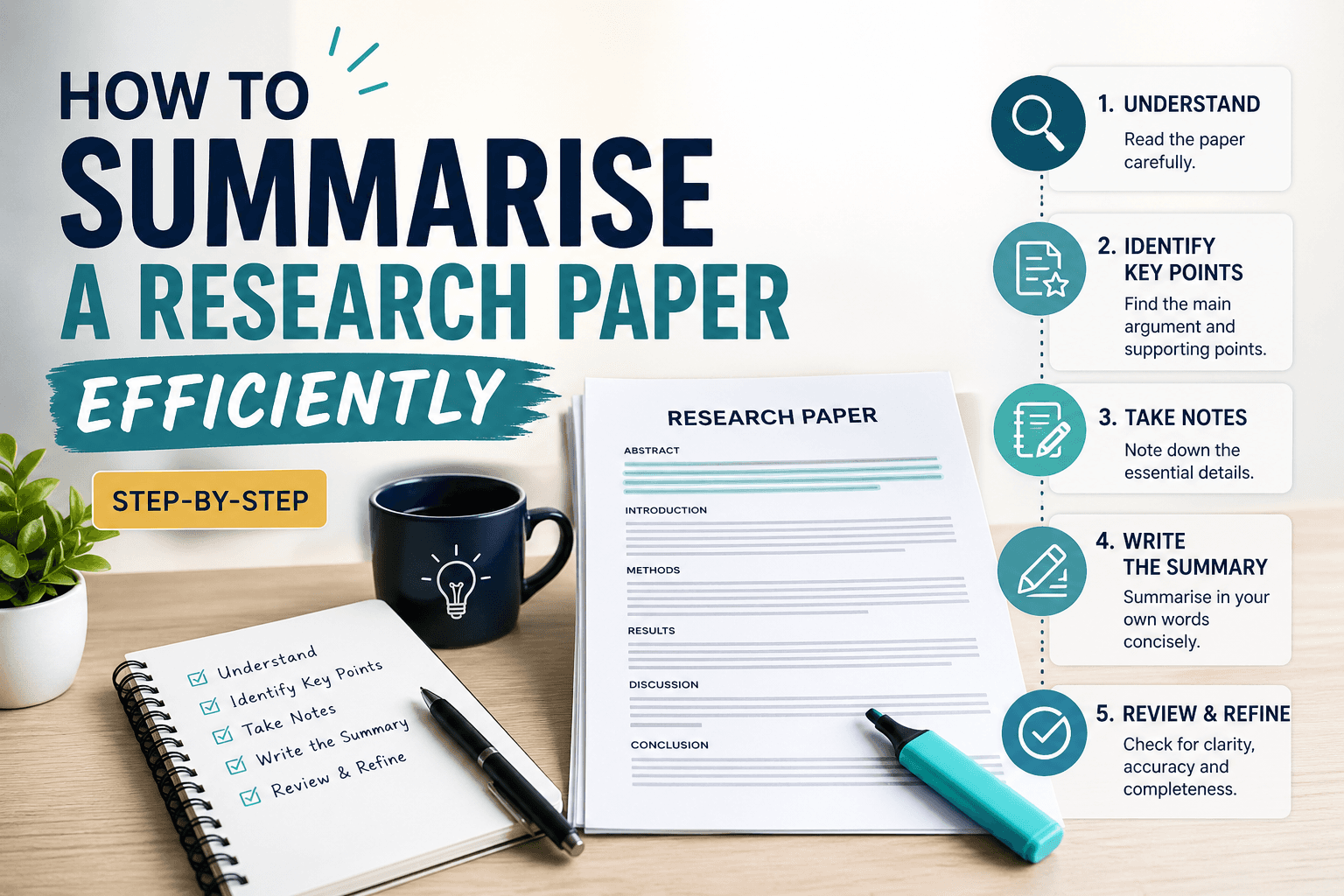
How to Summarise a Research Paper Efficiently (Step-by-Step)
Apr 29, 2026
Summarising a research paper is one of the most fundamental skills in academic work — and one of the least taught. Whether you are taking notes for a literature review, preparing a journal club presentation, or trying to quickly assess whether a paper is relevant to your research, knowing how to extract the key information from a paper efficiently can save hours of work every week.
This guide walks you through a practical, step-by-step framework for summarising any research paper — from understanding its structure to writing a clear, accurate summary that captures what actually matters.
Why Paper Summarisation Is a Core Research Skill
The volume of academic literature being published has never been higher. In biomedical research alone, over a million new papers are published every year. No researcher can read everything relevant to their field in full — which means the ability to quickly assess, extract, and summarise papers is not just a convenience but a professional necessity.
A good summary does three things: it captures the main research question and why it matters, it accurately represents the methods and findings, and it identifies the paper's limitations and relevance to your own work. A poor summary misses one or more of these and leads to misrepresentation of the literature — a common problem in research writing.
Step 1: Understand the Structure of a Research Paper
Before you can summarise a paper efficiently, you need to understand how it is structured. Most empirical research papers follow the IMRAD format:
Introduction — what question is the paper addressing and why does it matter? What gap in the existing literature does it fill?
Methods — how was the study conducted? What was the study design, sample, intervention, and analysis approach?
Results — what did the study find? What are the key data points, effect sizes, and statistical findings?
Discussion — how do the authors interpret their findings? What are the limitations? How do the results fit into the broader literature?
Conclusion — what is the main takeaway and what do the authors recommend for future research?
Understanding this structure means you know exactly where to look for each piece of information, rather than reading the entire paper linearly.
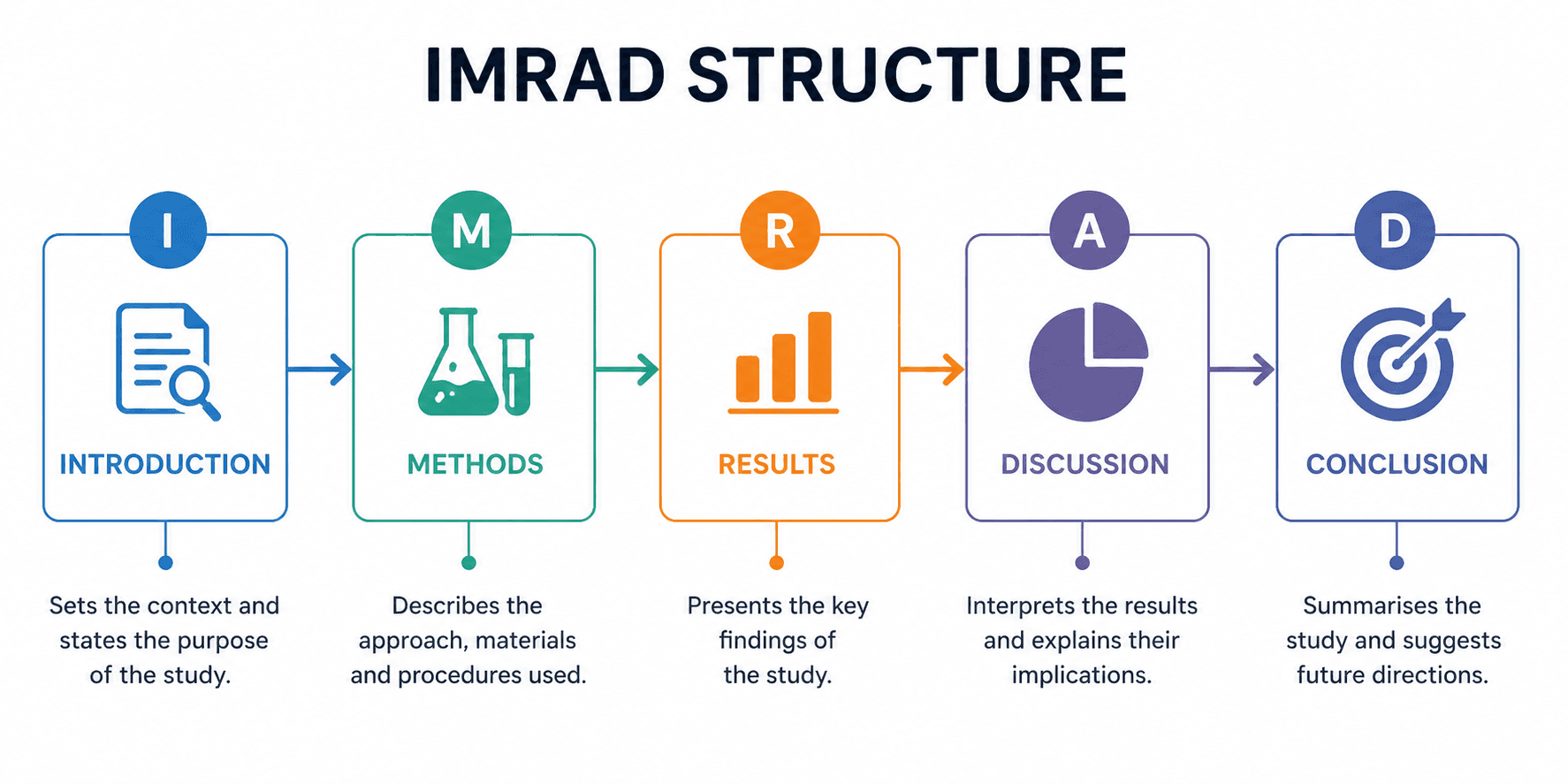
Caption: Most empirical research papers follow the IMRAD structure — understanding it lets you find key information without reading every word
Step 2: Read Strategically, Not Linearly
The biggest mistake researchers make when summarising a paper is reading it from start to finish before taking any notes. This approach is slow and often leads to missing the most important information.
Instead, read in this order:
First — read the abstract. The abstract is a compressed version of the entire paper. It tells you the research question, methods, key findings, and main conclusion. Reading it first gives you a mental map of the paper before you go deeper.
Second — read the introduction's final paragraph. This is almost always where the authors state their specific aims and hypotheses. It tells you exactly what they set out to do.
Third — read the results section headings and figures. Figures and tables contain the core data of the paper. Reading them before the full results section helps you understand what the study actually found.
Fourth — read the discussion's first and last paragraphs. The first paragraph of the discussion typically restates the main finding. The last paragraph typically contains the authors' conclusions and recommendations.
Fifth — go back and read the full paper only if the paper is highly relevant and you need a complete understanding of the methods and results.
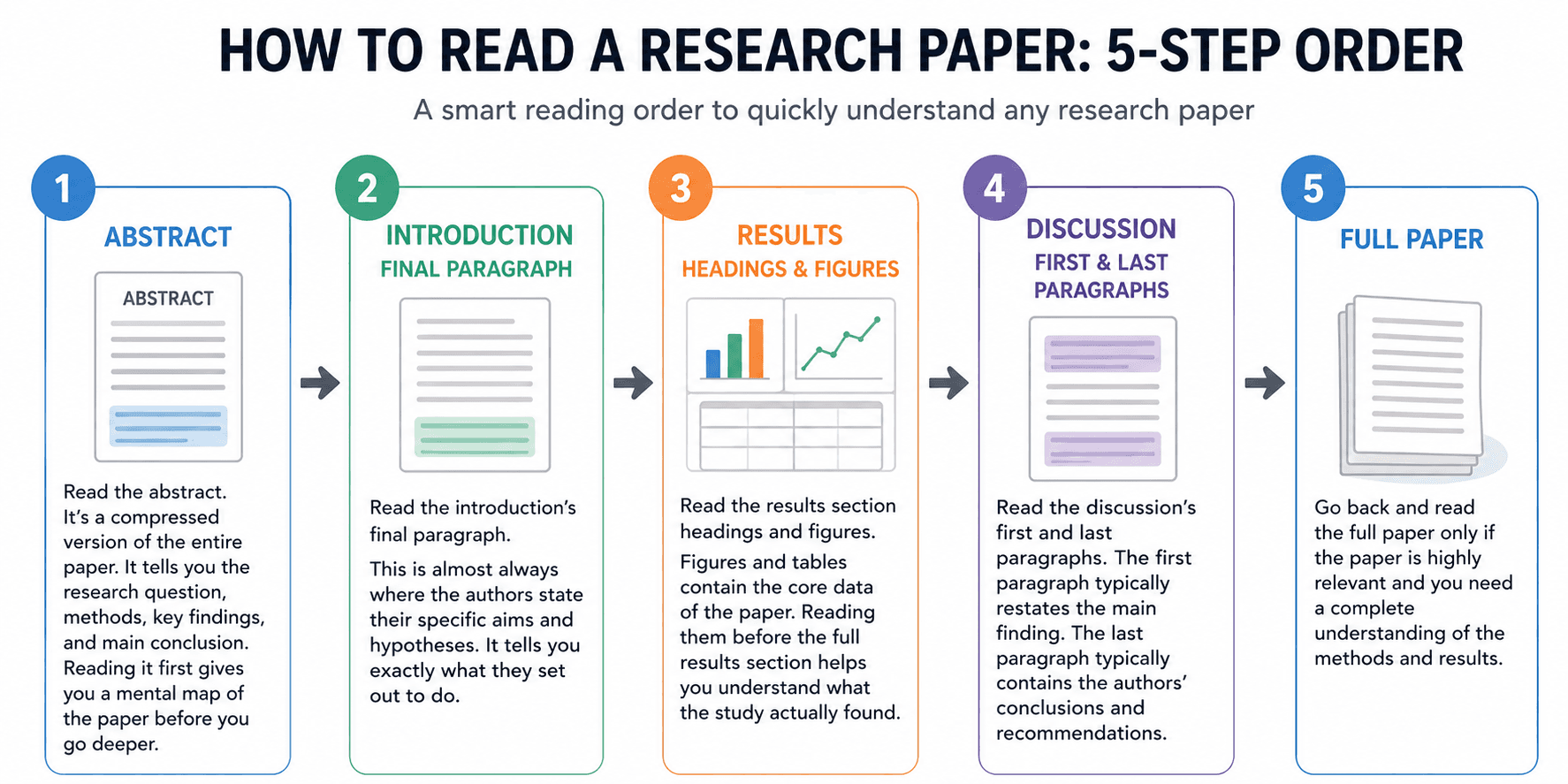
Caption: Reading a paper in this order rather than linearly can cut your summarisation time by half
Step 3: Take Structured Notes Using a Summary Template
As you read, take notes using a consistent template. This ensures you capture the same information from every paper, which makes comparison and synthesis much easier when you are working across multiple papers.
A simple but effective summary template includes:
Citation — author, year, journal, DOI
Research question — what specific question did the paper set out to answer?
Study design — what type of study was it? (RCT, observational, systematic review, qualitative, etc.)
Population/sample — who or what was studied? How large was the sample?
Intervention or exposure — what was done or measured?
Key findings — what were the main results? Include effect sizes and confidence intervals where relevant.
Limitations — what did the authors acknowledge as limitations? What did they miss?
Relevance to your work — how does this paper relate to your research question? Is it a key source, supporting evidence, or contradictory finding?
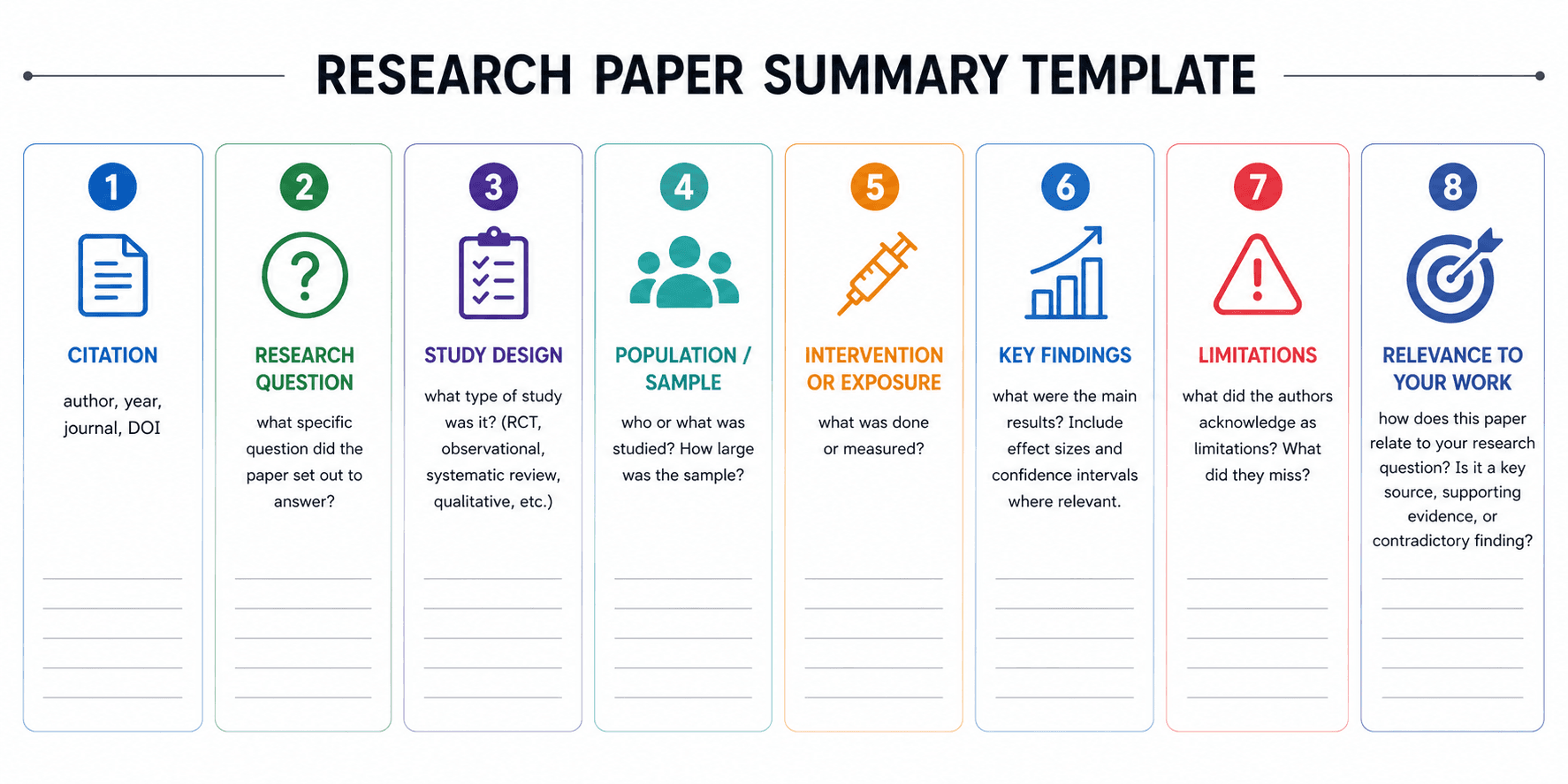
Caption: Using a consistent summary template for every paper makes synthesis significantly faster when you are working across multiple sources
Step 4: Write the Summary in Your Own Words
Once you have your notes, write the summary. A well-structured paper summary typically follows this format:
Opening sentence — state the research question and study design. For example: "This randomised controlled trial investigated the effect of low-carbohydrate diet on HbA1c levels in adults with Type 2 diabetes over 12 months."
Methods sentence — briefly describe the sample and key methods. For example: "The study enrolled 200 participants across three hospital sites and used a parallel group design with a control group receiving standard dietary advice."
Findings sentence — state the key result with the effect size. For example: "The low-carbohydrate group showed a significantly greater reduction in HbA1c compared to the control group (mean difference 0.8%, 95% CI 0.4 to 1.2, p less than 0.001)."
Limitation and relevance sentence — note the key limitation and why the paper matters to your work. For example: "The study was limited by high attrition at 12 months, but provides strong evidence for the intervention in a population directly relevant to our review."
This four-sentence structure works for most empirical papers and keeps summaries consistent and comparable across your notes.
Step 5: Use AI Tools to Speed Up the Process
AI research tools have made paper summarisation significantly faster for researchers who use them well. The key is understanding what AI tools are good at and where human judgment is still essential.
AI tools are good at: extracting key information from a paper quickly, identifying the study design and sample characteristics, summarising the abstract and discussion sections, and flagging limitations mentioned by the authors.
AI tools are not reliable for: interpreting whether the findings are clinically or practically significant, assessing methodological quality, identifying limitations the authors did not acknowledge, and contextualising findings within the broader literature.
The most effective approach is to use AI to handle the initial extraction — getting the basic information out of the paper quickly — and then apply your own judgment to assess relevance, quality, and meaning.
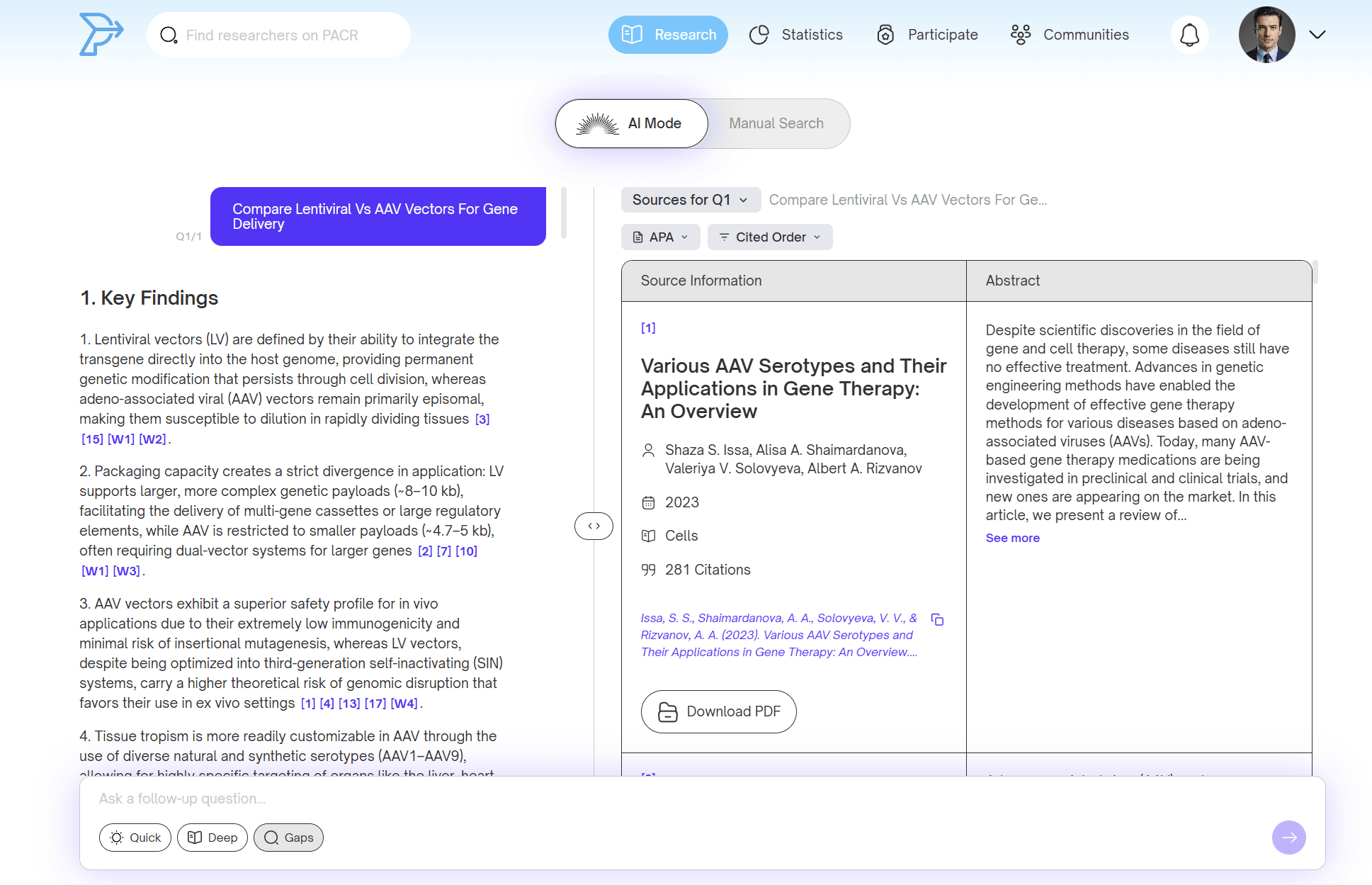
Caption: PACR's AI research assistant can extract and synthesise key findings from research papers — handling the initial extraction so you can focus on interpretation
Common Mistakes to Avoid
Copying the abstract — the abstract is a starting point, not a summary. Writing your own summary forces you to engage with and understand the paper.
Ignoring the limitations section — every paper has limitations. A summary that does not acknowledge them misrepresents the strength of the evidence.
Over-summarising methods — unless the methodology is directly relevant to your work, one sentence on study design and sample is usually sufficient.
Under-reporting effect sizes — a finding that is statistically significant is not necessarily meaningful. Always include the effect size, not just the p-value.
Confusing correlation with causation — observational studies cannot establish causation. Make sure your summary accurately reflects the study design and what the findings can and cannot show.
How Long Should a Paper Summary Be?
For most purposes, 100 to 200 words is the right length for a working paper summary. This is long enough to capture the key information but short enough to be useful as a reference note when you are writing.
For a more detailed critical appraisal — for example, when assessing a key paper for a systematic review — 400 to 600 words may be appropriate.
FAQ
How do I summarise a paper I do not fully understand? Start with the abstract and conclusion, which are written for a broader audience. Look up any terms you do not recognise before trying to summarise the methods or results. If the paper uses statistical methods you are unfamiliar with, focus on what the authors say the results mean rather than trying to interpret the numbers yourself.
How is a summary different from a critique? A summary describes what the paper did and found. A critique evaluates whether it did so well — assessing the appropriateness of the methods, the validity of the conclusions, and the significance of the contribution. A good critical appraisal includes both.
Can I use AI to summarise papers for my literature review? Yes, with caveats. AI tools can significantly speed up initial extraction but should not replace careful reading of key papers. Use AI for initial screening and note-taking, then read the most relevant papers in full.
How many papers should I summarise for a literature review? This depends on the scope of your review. A targeted review of a specific intervention might require 20 to 50 papers. A comprehensive systematic review might require summarising hundreds. AI-assisted tools that synthesise across multiple papers simultaneously can significantly reduce the time required for large-scale reviews.
What is the best tool for summarising research papers? It depends on your workflow. For discovery and synthesis across multiple papers, PACR is the strongest option. For extracting specific information from individual PDFs, SciSpace is excellent. For structured data extraction across many papers for a systematic review, Elicit's table feature is particularly useful.