5 Biggest Breakthroughs in AI-Powered Research Tools in 2026
Mar 1, 2026
Artificial intelligence is reshaping how researchers find, read, and synthesise academic literature — and 2025 has already delivered several significant developments worth paying attention to. Whether you're a sceptic or an early adopter, these shifts are changing the practical reality of academic research workflows across every discipline.
1. AI Literature Synthesis Goes Mainstream
For years, AI-assisted search meant better keyword matching. In 2025, it means getting a synthesised answer — drawn from real, cited academic papers — in response to a natural language question. Platforms like PACR now allow researchers to ask questions like "What does the evidence say about metformin and cognitive decline?" and receive a structured response with citations, rather than a list of links to sift through.
This shift from retrieval to synthesis is arguably the biggest change in academic search in a generation. Researchers who adopt these tools are reporting significant reductions in the time spent on preliminary literature reviews.
📸 Video: PACR searches PubMed, arXiv, Crossref, and DOAJ simultaneously — no tab switching needed
2. Preprint AI Integration Is Accelerating Discovery
The volume of preprints on arXiv and bioRxiv has grown dramatically, and AI tools are increasingly indexing and synthesising this content in real time — meaning researchers can access emerging findings weeks or months before formal publication. This is particularly impactful in fast-moving fields like AI itself, genomics, and climate science, where the gap between discovery and peer-reviewed publication creates a meaningful information lag.
3. Multi-Database Search Is Becoming the Standard
Researchers have long had to hop between PubMed, Scopus, Embase, Google Scholar, and arXiv to conduct comprehensive searches. In 2025, unified multi-database platforms are consolidating this workflow. PACR's integration of PubMed, arXiv, Crossref, and DOAJ into a single search interface reflects a broader industry trend: researchers should not have to manage multiple logins and search syntaxes to conduct one literature review.
Expect this consolidation to accelerate as more platforms compete for the research workflow.
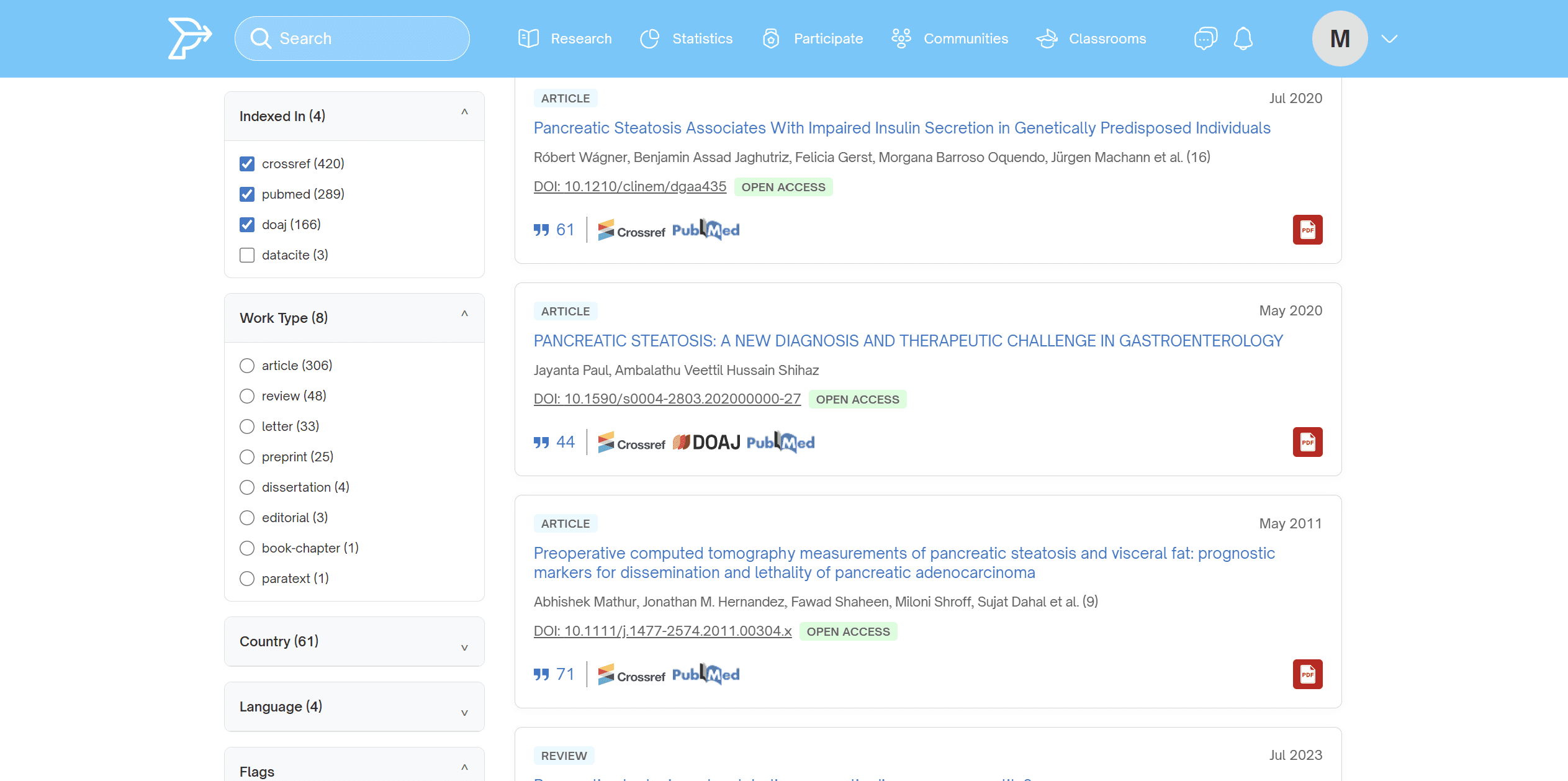
📸 Photo: PACR searches PubMed, arXiv, Crossref, and DOAJ simultaneously — no tab switching needed
4. AI Research Agents Are Moving From Lab to Field
Beyond assistants that answer questions, fully autonomous AI research agents — capable of formulating hypotheses, searching literature, running computational experiments, and drafting findings — are moving from research labs into experimental use by academic institutions. Groups at Stanford, DeepMind, and several European research universities have published early results on AI systems that can conduct substantial portions of a research cycle autonomously.
This doesn't mean AI is replacing researchers. It means the definition of a researcher's job is shifting toward directing, evaluating, and contextualising AI-generated work — a meaningful change in what scientific expertise looks like in practice.
5. Research Platforms Are Adding Social and Protocol Layers
The traditional separation between social academic networks, database search, and protocol sharing is collapsing. New platforms are integrating all three — letting researchers search the literature, connect with collaborators, and access the protocols behind the research they find, all without leaving a single interface.
PACR's development roadmap includes protocols.io integration, which would give researchers direct access to lab protocols alongside the papers that reference them — a workflow improvement that bench scientists in particular have been requesting for years.
What This Means for Researchers
The practical implication of these five developments is straightforward: the gap between researchers who use AI tools and those who don't is widening. Early adopters are conducting literature reviews faster, staying more current in their fields, and spending less time on the administrative overhead of research. The tools are no longer experimental — they are increasingly the baseline expectation.
If you haven't explored what AI-powered research platforms can do for your workflow in 2025, now is a reasonable time to start. PACR offers a free starting point at pacr.co.
Sources: arXiv submission statistics (arxiv.org), bioRxiv growth data (biorxiv.org), Nature commentary on AI in science (2025), DeepMind research agents paper (2024)