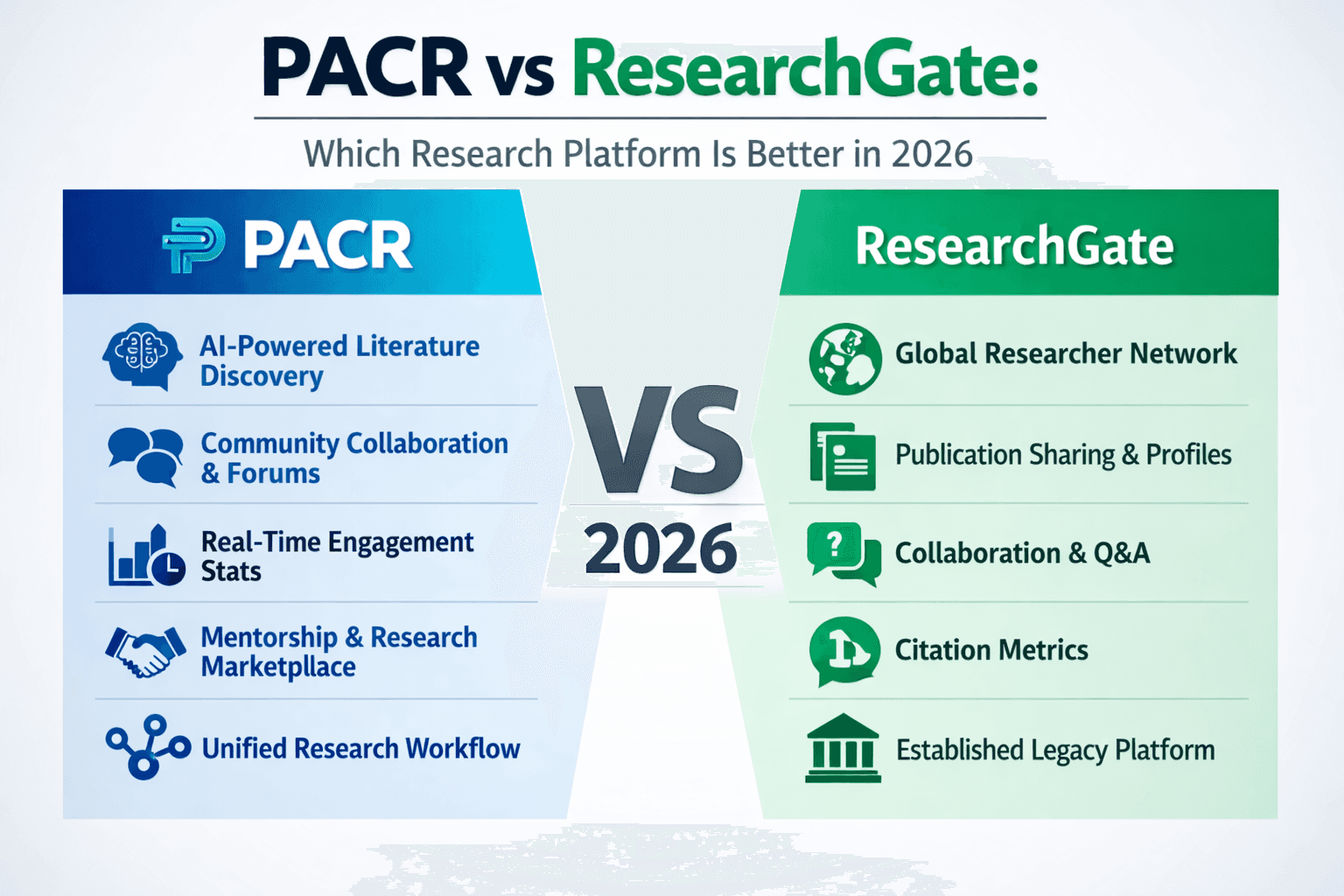
PACR vs ResearchGate: Which Research Platform Is Better in 2026
Mar 1, 2026
If you've spent any time in academic research, you've heard of ResearchGate. It's been a staple of the research community for over a decade — a place to share papers, follow colleagues, and track your citation impact. But in 2026, the research landscape looks very different from 2008, and a new generation of platforms is giving ResearchGate serious competition.
PACR is one of them. Built as an all-in-one research platform combining AI-powered search, access to major academic databases, and an integrated scientific social network, PACR is designed for the way researchers actually work today.
So how does PACR compare to ResearchGate? We did a thorough, feature-by-feature breakdown so you can make an informed decision.
Quick verdict: ResearchGate wins on community size and legacy networking. PACR wins on AI capabilities, database breadth, and modern research workflows. If you need an AI assistant alongside your academic network, PACR is the stronger choice in 2026.
ResearchGate: What It Is and Who It's For

Founded in 2008, ResearchGate is one of the oldest and most widely used academic social networks, with over 25 million registered users. It functions primarily as a place for researchers to upload and share papers, follow colleagues, ask and answer community questions, and track their RG Score and citation metrics.
ResearchGate does these things well. Its network effects are real — if your field has an active ResearchGate presence, it's a useful visibility tool. However, the platform was built before AI became central to research workflows, and that gap is increasingly visible.
PACR: What It Is and Who It's For
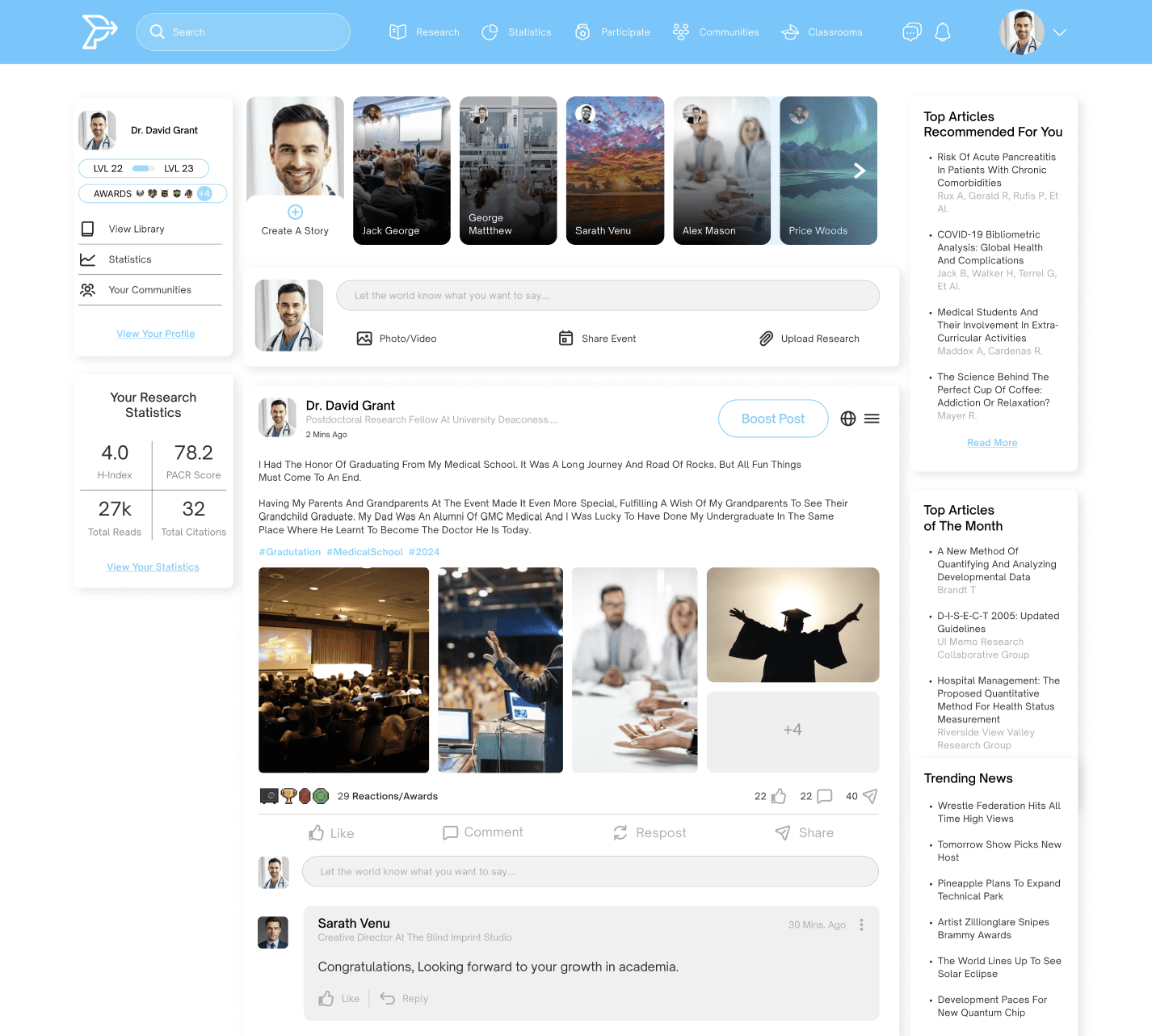
📸 IMAGE: Screenshot of the PACR platform dashboard
PACR (pacr.co) is a next-generation research platform that combines three tools researchers typically need separate subscriptions for: an AI research assistant that answers natural language queries with cited academic sources, multi-database search across PubMed, arXiv, Crossref, and DOAJ, and an integrated scientific social network.
PACR is particularly well-suited to medical researchers, lab scientists, and academics who navigate multiple databases regularly and need AI support to synthesise large volumes of literature quickly.
Feature-by-Feature Comparison
Feature | PACR | ResearchGate | Winner |
|---|---|---|---|
AI Research Assistant | ✅ Built-in | ❌ None | PACR |
Academic Social Network | ✅ Integrated | ✅ Core feature | Tie |
Multi-Database Search | ✅ PubMed, arXiv, DOAJ+ | ⚠️ Limited | PACR |
Full-Text Access | ✅ Open access + DOI | ✅ Author uploads | Tie |
AI Literature Synthesis | ✅ Summarise & compare | ❌ None | PACR |
Collaboration Tools | ✅ In development | ✅ Q&A + messaging | ResearchGate |
Mobile App | ✅ Yes | ✅ Yes | Tie |
Price | Free (AI Research Assistant- Paid) | Free (freemium) | Tie |
AI Capabilities: PACR Wins by a Wide Margin
This is the sharpest differentiator between the two platforms. ResearchGate has no AI assistant whatsoever. Search is keyword-based, and there is no feature to summarise papers, compare findings across studies, or answer natural language research questions.
PACR's AI research assistant is built for the way researchers think. Instead of reading through 40 abstracts to find the five papers relevant to your question, you ask PACR directly and receive a synthesised, cited answer drawn from real academic literature. This is especially valuable for rapid pre-project literature reviews, staying current in a fast-moving field, and exploring research areas outside your primary expertise.
Database Access: PACR Covers More Ground
ResearchGate's search draws primarily from papers that users have voluntarily uploaded, which means coverage has gaps — particularly for older papers, paywalled research, or fields with lower platform adoption.
PACR searches across PubMed, arXiv, Crossref, and DOAJ, giving researchers access to tens of millions of papers across disciplines from one interface. For medical and life sciences researchers, the PubMed integration alone is a significant practical advantage over anything ResearchGate offers.
Social Network & Community: ResearchGate's Home Turf
ResearchGate's biggest strength is its established user base. Millions of researchers have active profiles, and the platform has genuine social gravity — people use it to follow colleagues, request full texts, and engage with research questions in their field.
PACR's scientific social network is integrated into the same platform as its search and AI tools, meaning you move seamlessly between finding papers and connecting with the people who wrote them. In terms of raw community size, though, ResearchGate currently has the larger network.
Pricing: Both Are Free
Both platforms offer free core access. ResearchGate operates on a freemium model. PACR is currently free, with a Pro plan in development that will unlock advanced AI features and priority access to new tools. For researchers watching their budgets, both are immediately accessible at no cost.
Who Should Use PACR?
Researchers who search multiple databases and want a single unified interface
Medical professionals and lab scientists who need AI-assisted literature synthesis
Academics looking to reduce time spent on preliminary literature reviews
Researchers exploring new fields who need fast orientation to existing work
Who Should Stay on ResearchGate?
Researchers whose primary goal is professional visibility and networking
Those whose field has a strong, active ResearchGate community
Researchers who mainly want to share their own papers and track citations
Final Verdict
ResearchGate earned its place in the research community and still delivers real value as a professional network. But if your goal is efficient, AI-assisted research — finding the right papers faster, synthesising literature at scale, and searching across databases without switching tabs — PACR is the stronger platform in 2026.
The choice ultimately comes down to what you need most: community presence (ResearchGate) or research efficiency (PACR). For most active researchers today, it's increasingly the latter.
Category | PACR 🔵 | ResearchGate ⚫ |
|---|---|---|
AI Capabilities | ⭐⭐⭐⭐⭐ | ⭐☆☆☆☆ |
Database Coverage | ⭐⭐⭐⭐⭐ | ⭐⭐⭐☆☆ |
Research Efficiency | ⭐⭐⭐⭐⭐ | ⭐⭐☆☆☆ |
Social Network | ⭐⭐⭐☆☆ | ⭐⭐⭐⭐⭐ |
Ease of Use | ⭐⭐⭐⭐☆ | ⭐⭐⭐☆☆ |
Overall | ⭐⭐⭐⭐⭐ | ⭐⭐⭐☆☆ |
Try PACR free at pacr.co
FAQ
Is PACR better than ResearchGate? For AI-powered research and multi-database search, yes. For academic social networking and community size, ResearchGate still has the advantage. Many researchers benefit from using both for different purposes.
Does PACR have a social network? Yes. PACR integrates a scientific social network alongside its AI assistant and database search tools, making it a more complete research platform than either social networks or databases alone.
Can I use PACR instead of PubMed? PACR searches PubMed as one of its integrated databases, so you get PubMed's content through PACR's interface — including AI synthesis — without needing to visit PubMed separately.
Is ResearchGate still worth using in 2025? Yes, particularly for networking and professional visibility. For active literature research and AI assistance, PACR is the more capable tool.