Best Research Paper Summarizer Tools in 2026 (Free & Paid)
Mar 3, 2026
Reading research papers is one of the most time-consuming parts of academic work. A dense 40-page paper can take hours to read carefully — and when you are working through dozens of papers for a literature review, that time adds up fast. Research paper summarizer tools have emerged as one of the most practical applications of AI in academia, helping researchers extract key findings, methods, and conclusions from papers in a fraction of the time.
But not all summarizer tools are built the same. Some are simple text summarizers with no understanding of academic structure. Others are purpose-built for scientific literature, capable of pulling out methodology, results, and limitations with genuine accuracy.
Here is a full breakdown of the best research paper summarizer tools available in 2026 — free and paid.
What Makes a Good Research Paper Summarizer?
Before diving into the tools, it is worth understanding what separates a good academic summarizer from a generic one. The best tools share several characteristics:
Citation accuracy — the tool should correctly attribute findings to their source papers and not hallucinate references.
Structure awareness — academic papers follow a specific structure (introduction, methods, results, discussion). A good summarizer understands this structure and can extract information from the right sections.
Multi-paper synthesis — the most powerful tools do not just summarise individual papers, they synthesise findings across multiple papers to answer a specific research question.
Database integration — tools that connect directly to academic databases like PubMed or arXiv are significantly more useful than tools that only work on papers you manually upload.
1. PACR — Best Overall for Researchers
PACR is the strongest research paper summarizer available in 2026 for one key reason: it combines summarization with multi-database search. Rather than uploading a paper and getting a summary, you ask a research question in natural language and PACR searches across PubMed, arXiv, Crossref, and DOAJ to find the most relevant papers — then synthesises the findings into a cited answer.
This is the difference between summarising what you already have and discovering what you need. For researchers conducting literature reviews, the latter is significantly more valuable.
Key features:
Natural language research questions answered with cited sources
Multi-database search across PubMed, arXiv, Crossref, and DOAJ
AI synthesis across multiple papers simultaneously
Integrated scientific social network
Free to use
Best for: Researchers, medical professionals, lab scientists, PhD students
Price: Free (with paid plan option for unlimited use)
📸 IMAGE: PACR answers research questions by synthesising findings across multiple papers — not just summarising one at a time
2. Elicit — Best for Systematic Reviews
Elicit is a purpose-built research assistant that excels at literature review tasks. Its table extraction feature is particularly useful — it can pull data from multiple papers simultaneously and display them in a structured table, making it easy to compare methodologies and results across studies.
Key features:
Literature search with AI-powered filtering
Table extraction across multiple papers
Research question decomposition
Integration with Semantic Scholar
Best for: Researchers conducting systematic reviews and comparative analyses
Price: Free tier available, paid plans from $10/month
📸 IMAGE: Elicit's table extraction feature allows researchers to compare findings across multiple papers simultaneously
3. Consensus — Best for Quick Evidence Checks
Consensus is designed for fast evidence retrieval. You ask a yes/no or open question — "Does coffee improve cognitive performance?" — and it returns a consensus meter showing what the weight of research says, along with the papers behind it.
Key features:
Consensus meter showing weight of evidence
Quick yes/no research question answering
Citation-backed responses
Clean, simple interface
Best for: Quick evidence checks, non-specialist researchers, medical professionals
Price: Free tier available, paid plans from $9.99/month
4. SciSpace — Best for Reading Individual Papers
SciSpace (formerly Typeset) is built around the experience of reading a single paper. Upload a PDF and you can ask questions directly about its content — "What was the sample size?", "What were the main limitations?" — and get precise, accurate answers drawn from that specific paper.
Key features:
PDF upload and question answering
In-paper highlighting and annotation
Literature review feature for multiple papers
Chrome extension for reading papers online
Best for: Researchers who need to extract specific information from individual papers quickly
Price: Free tier available, paid plans from $12/month
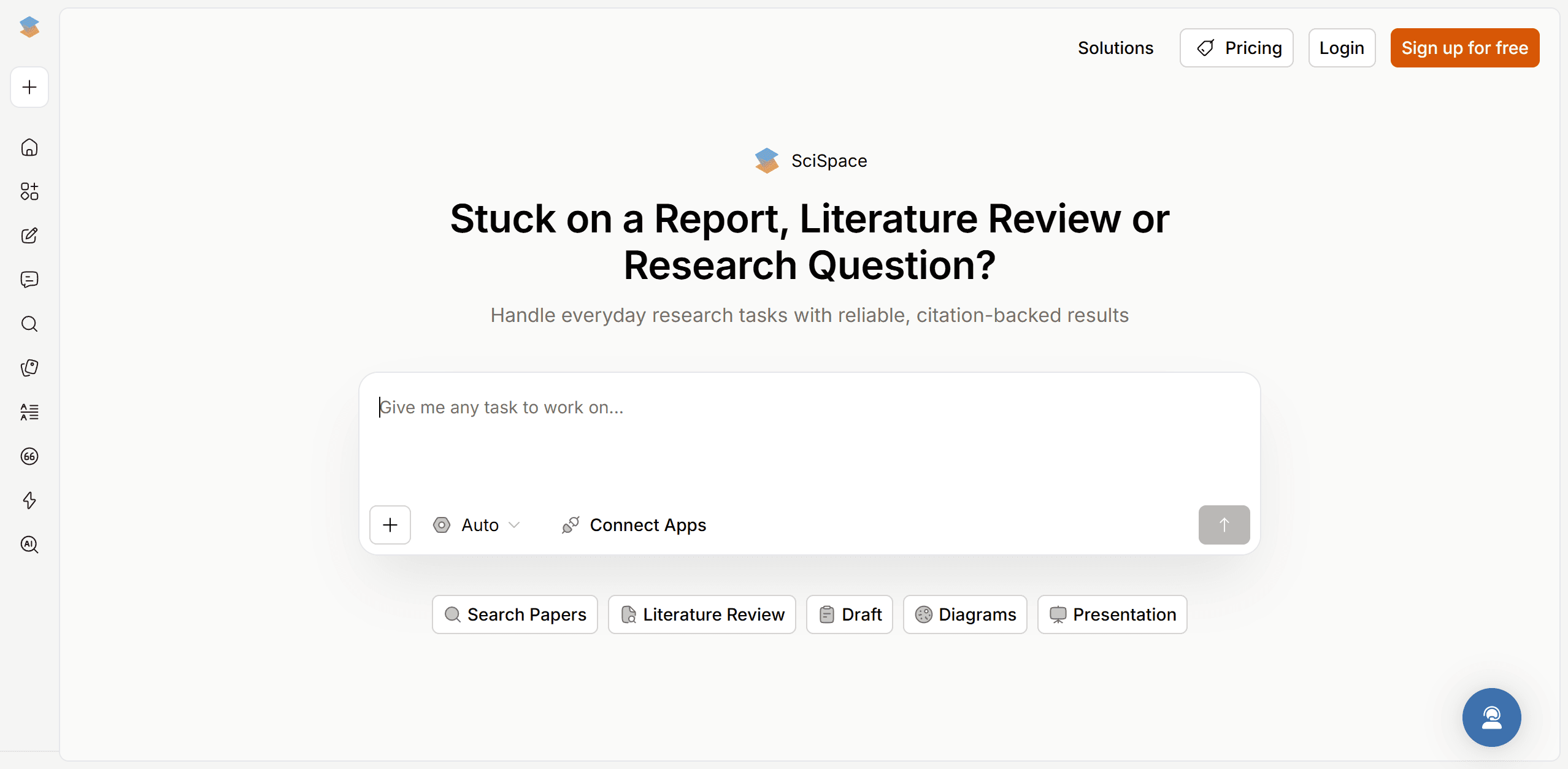
📸 IMAGE: SciSpace allows researchers to ask specific questions about individual papers and get precise, cited answers
5. ChatGPT (with file upload) — Most Widely Used but Least Reliable
ChatGPT is probably the most widely used tool for paper summarization simply because of its massive user base. With file upload, you can paste or upload a paper and ask for a summary, explanation, or specific information.
However it has significant limitations for academic use: it can hallucinate citations, it has no direct connection to academic databases, and it has no built-in mechanism for verifying whether its summaries are accurate.
Best for: Quick informal overviews of papers you already have, non-critical summarization tasks
Price: Free tier available, ChatGPT Plus at $20/month
6. Google NotebookLM — Best for Personal Research Libraries
Google NotebookLM allows researchers to upload multiple documents and then ask questions across all of them simultaneously. For researchers who have already collected a set of papers and want to synthesise them, it is a genuinely useful tool.
Key features:
Upload multiple PDFs and ask questions across all of them
Source grounding — responses are tied directly to your uploaded documents
Audio overview feature
Free to use
Best for: Researchers synthesising a pre-collected set of papers
Price: Free
Comparison Table
Tool | Best For | Database Search | Multi-Paper Synthesis | Price |
|---|---|---|---|---|
PACR | Overall research workflows | ✅ PubMed, arXiv, DOAJ+ | ✅ Yes | Free |
Elicit | Systematic reviews | ✅ Semantic Scholar | ✅ Yes | Free / $10+ |
Consensus | Quick evidence checks | ✅ Limited | ✅ Yes | Free / $9.99+ |
SciSpace | Reading individual papers | ❌ Limited | ⚠️ Limited | Free / $12+ |
ChatGPT | Informal summaries | ❌ None | ⚠️ Limited | Free / $20 |
NotebookLM | Personal paper libraries | ❌ Upload only | ✅ Yes | Free |
Which Research Paper Summarizer Should You Use?
For most researchers the answer depends on what stage of the research process you are in. If you are in the discovery and literature review phase — searching for papers, mapping a field, synthesising evidence — PACR is the strongest tool because it combines search with synthesis. If you are in the reading phase — working through a specific set of papers you have already identified — SciSpace or NotebookLM are excellent companions.
For systematic reviews requiring structured data extraction across many papers, Elicit's table feature is particularly valuable and worth exploring alongside PACR.
FAQ
Are research paper summarizer tools accurate? Accuracy varies significantly between tools. Tools that are grounded in specific source documents — like SciSpace and NotebookLM — tend to be more accurate than general AI tools like ChatGPT, which can hallucinate details. Purpose-built academic tools like PACR and Elicit are designed with citation accuracy as a priority.
Can I use AI summarizer tools for a systematic literature review? AI tools can significantly speed up the discovery and initial screening phases of a systematic review, but the formal inclusion, quality assessment, and data extraction stages still require human judgment and documented methodology. See our full guide on how to do a systematic literature review for more detail.
Are these tools free? Most tools on this list offer a free tier. PACR and Google NotebookLM are fully free. Elicit, Consensus, and SciSpace offer free tiers with paid plans for advanced features.
Do these tools work with all academic disciplines? Tools connected to PubMed are strongest for biomedical and clinical research. Tools connected to arXiv are strongest for physics, mathematics, and computer science. PACR's multi-database coverage gives it the broadest disciplinary reach of any tool on this list.