New Study Reveals How Researchers Discover Academic Papers in 2026
Mar 2, 2026
How do researchers actually find the papers they read? It sounds like a simple question, but the answer has changed dramatically over the past decade — and a growing body of research is revealing that the way academics discover literature is more varied, more digital, and more AI-influenced than ever before.
Understanding how paper discovery actually works matters for researchers, for platform builders, and for anyone thinking about how scientific knowledge spreads through the academic community.
The Old Way: Database Searches and Reference Lists
For most of the twentieth century, researchers found papers through two primary routes: searching bibliographic databases and following citations in papers they had already read. A researcher would run a keyword search in a database like MEDLINE or PsycINFO, retrieve a list of results, and then trace relevant citations through the reference lists of those papers.
This approach is still used and still valuable — but it is no longer how most researchers discover the majority of the literature they read.
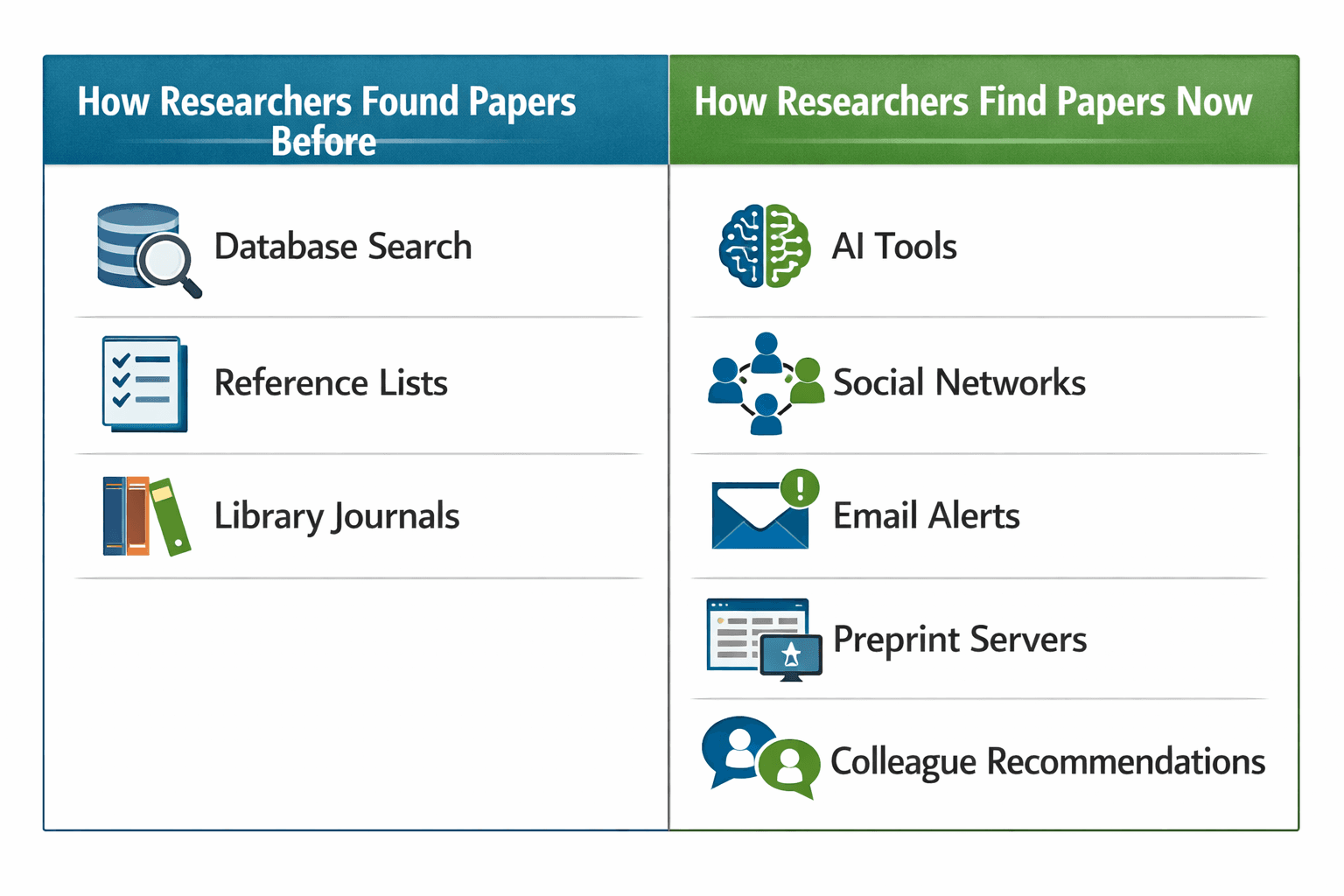
📸 IMAGE: The shift in how researchers discover academic literature over the past decade
How Researchers Find Papers Today
Research into academic discovery habits consistently identifies several dominant channels used by researchers in 2026:
Google Scholar remains the single most used starting point for paper discovery across disciplines. Its broad coverage and simple interface make it the default first stop for many researchers, particularly early-career academics.
Reference lists and citations remain a powerful discovery mechanism. Finding one relevant paper and tracing its citations — and the papers that cite it — is still one of the most effective ways to map a literature quickly.
Email alerts and journal notifications are widely used by researchers who want to stay current in their field. Most major databases including PubMed and Scopus offer customisable email alerts for new papers matching specific keywords or authors.
Colleague recommendations remain surprisingly influential. Researchers frequently discover important papers through informal conversations, social media posts from peers, and recommendations from supervisors and collaborators.
Preprint servers like arXiv and bioRxiv have become major discovery channels in fields like physics, biology, and AI, where the speed of preprint publication means new findings circulate months before formal publication.
AI-powered platforms are the fastest-growing discovery channel. Tools that synthesise literature and surface relevant papers in response to natural language questions are changing how researchers explore new fields and stay current in their own.
The Discovery Gap Problem
One of the most consistent findings in research on literature discovery is what researchers call the discovery gap — the difference between the papers researchers find and the papers that are most relevant to their work.
Even experienced researchers using multiple search strategies regularly miss important papers. Studies have found that keyword-based searches in a single database typically surface only a fraction of the relevant literature on a given topic. The papers that get found tend to be the most cited, the most recent, or the ones written in English — which systematically underrepresents certain fields, regions, and research traditions.
AI-powered search tools are beginning to address this problem by expanding the search space, identifying conceptually related papers that do not share obvious keywords, and synthesising findings across a broader literature than any individual researcher could manually review.
What This Means for How You Search
The practical implication of the discovery research is clear: relying on a single search channel means missing significant portions of the relevant literature. Researchers who use multiple discovery channels — combining database searches, citation tracing, preprint monitoring, and AI-assisted synthesis — consistently find more relevant literature than those who rely on keyword searches alone.
For researchers conducting a systematic or comprehensive literature review, this has direct methodological implications. Single-database searches are no longer considered sufficient by most journal editors and systematic review guidelines.
📸 VIDEO: PACR searches across PubMed, arXiv, Crossref, and DOAJ simultaneously — addressing the single-database discovery gap
The Role of AI in Literature Discovery
The most significant shift in paper discovery over the past two years has been the rise of AI-assisted search. Rather than returning a list of keyword-matched results, AI research tools can now synthesise findings across thousands of papers and surface the most relevant evidence in response to a specific research question.
This changes not just how researchers find papers, but how they engage with literature. Instead of reading 40 abstracts to identify the 5 relevant papers, a researcher can ask a direct question and receive a synthesised answer with citations — and then go deeper into the specific papers that matter.
The adoption of AI discovery tools is currently fastest among early-career researchers and in fast-moving fields where staying current with a rapidly expanding literature is a significant challenge.
The Social Layer of Discovery
An underappreciated aspect of paper discovery is its social dimension. Research consistently shows that informal recommendations from colleagues, supervisors, and peers on academic social networks are a significant source of paper discovery — particularly for foundational or classic papers that might not surface in a keyword search.
This is part of the reason that integrated platforms combining database search, AI assistance, and a scientific social network offer a more complete discovery experience than standalone databases. The social layer of discovery — the colleague recommendation, the shared preprint, the discussion thread — is a genuine part of how researchers find important work.
Key Takeaways for Researchers
No single discovery channel is sufficient for comprehensive literature coverage
AI-assisted search tools are the fastest-growing and most impactful new channel
Citation tracing remains one of the most effective strategies for mapping a literature
Social and informal channels are more significant in discovery than most researchers acknowledge
Multi-database search platforms significantly reduce the discovery gap compared to single-database approaches
FAQ
What is the most common way researchers find papers? Google Scholar is the most widely used starting point for paper discovery, but most researchers use multiple channels including citation tracing, email alerts, colleague recommendations, and increasingly AI-powered tools.
Why do researchers miss relevant papers? The discovery gap is caused by reliance on single databases, keyword limitations, language bias toward English-language publications, and the sheer volume of literature being published. AI tools and multi-database search platforms are beginning to close this gap.
How can I make sure I am not missing important papers? Use multiple discovery channels: run searches across several databases, trace citations in relevant papers, set up email alerts for key topics, and use AI-assisted tools that can synthesise across a broader literature than keyword searches alone.
Are AI tools reliable for finding research papers? The best AI research tools surface papers from indexed, peer-reviewed sources and provide citations for every claim. As with any search tool, results should be verified and complemented with targeted database searches for comprehensive literature reviews.
How do preprint servers affect paper discovery? Preprint servers like arXiv and bioRxiv allow researchers to access findings months before formal publication, which is particularly valuable in fast-moving fields. AI tools that index preprints alongside peer-reviewed literature give researchers the most current view of a field.
Also see our comparison of PACR vs Academia.edu and our guide on what is peer review for more on modern research workflows.