What Is Peer Review? A Complete Guide for Early-Career Researchers
Mar 2, 2026
If you are new to academic research, peer review is one of the first processes you will encounter — and one of the least explained. Most researchers learn about it through experience rather than instruction, which leads to a lot of confusion, frustration, and avoidable mistakes early in a career.
This guide covers everything you need to know about peer review: what it is, how it works, the different types, its strengths and weaknesses, and how to navigate it successfully whether you are submitting your first paper or reviewing one for the first time.
What Is Peer Review?
Peer review is the process by which a piece of academic work — typically a research paper, grant proposal, or conference submission — is evaluated by other experts in the same field before it is published or funded. The purpose is to ensure the work meets the quality and rigour standards of the discipline.
When a researcher submits a paper to a journal, the editor sends it to two or three independent experts — the peer reviewers — who read the paper and provide a detailed assessment. Based on their feedback, the editor makes one of four decisions: accept the paper as is, accept it with minor revisions, ask for major revisions and resubmission, or reject it outright.
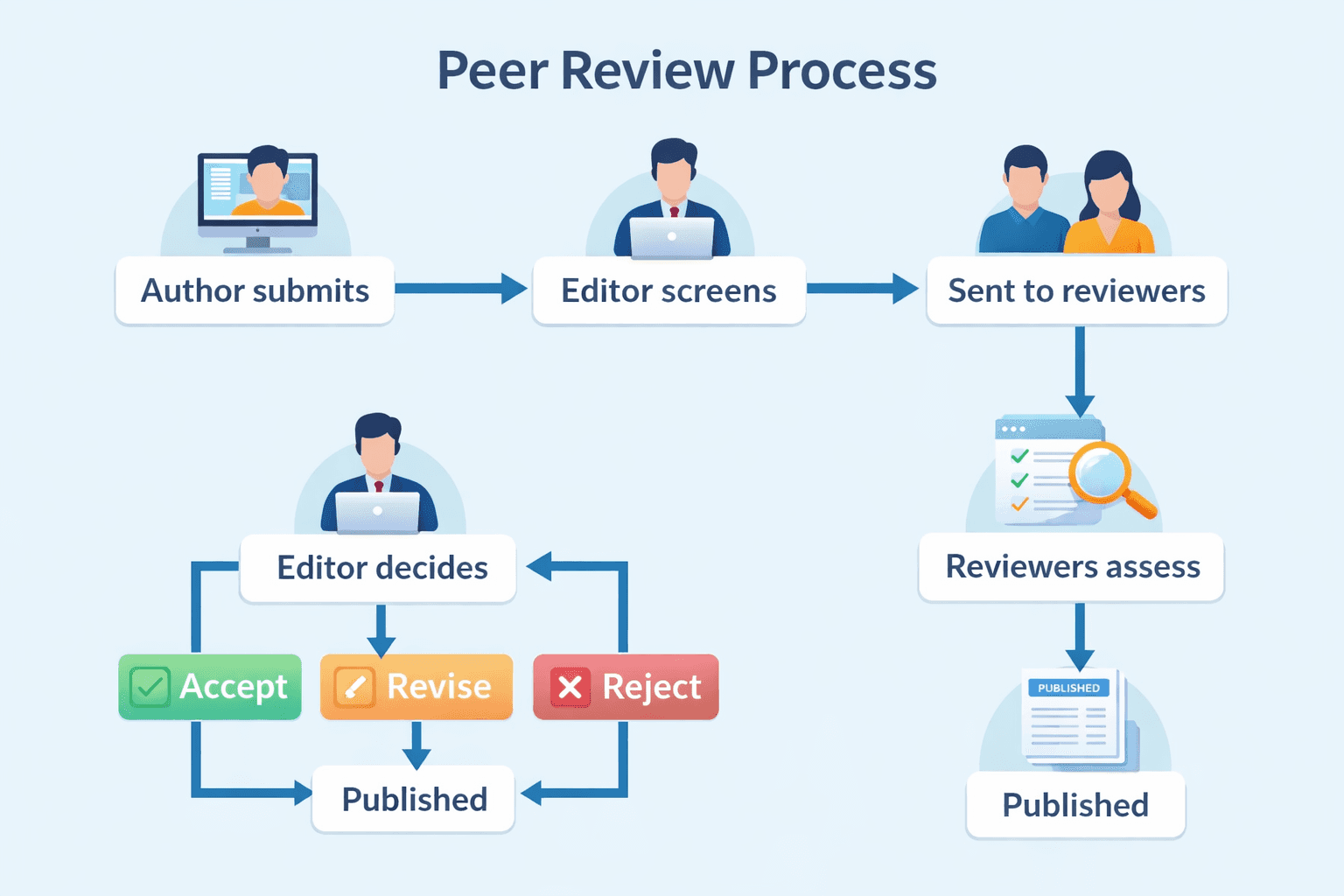
📸 IMAGE: The standard peer review process from initial submission through to publication decision
Why Does Peer Review Exist?
Peer review exists to maintain the quality and credibility of scientific literature. Without it, anyone could publish anything under the banner of "research," making it impossible to distinguish rigorous science from speculation or fraud.
For readers of academic literature, peer review is a quality signal — a paper that has passed peer review has at least been evaluated by experts in the field, even if it is not a guarantee of perfection. For funders and institutions, peer-reviewed publications are the primary currency of academic achievement. You can find peer-reviewed literature across all major fields through PACR's multi-database search, which covers PubMed, arXiv, and DOAJ simultaneously.
The Four Main Types of Peer Review
Not all peer review works the same way. There are four main models used by journals today:
Single-blind peer review — the reviewers know who the authors are, but the authors do not know who the reviewers are. This is the most common model.
Double-blind peer review — neither the authors nor the reviewers know each other's identities. This is designed to reduce bias in the review process.
Open peer review — the identities of both authors and reviewers are known to each other, and in some cases the reviews are published alongside the paper. This model is growing in popularity in the open science movement.
Post-publication peer review — the paper is published first and then reviewed by the community. This model is more common with preprints on platforms like arXiv and bioRxiv.
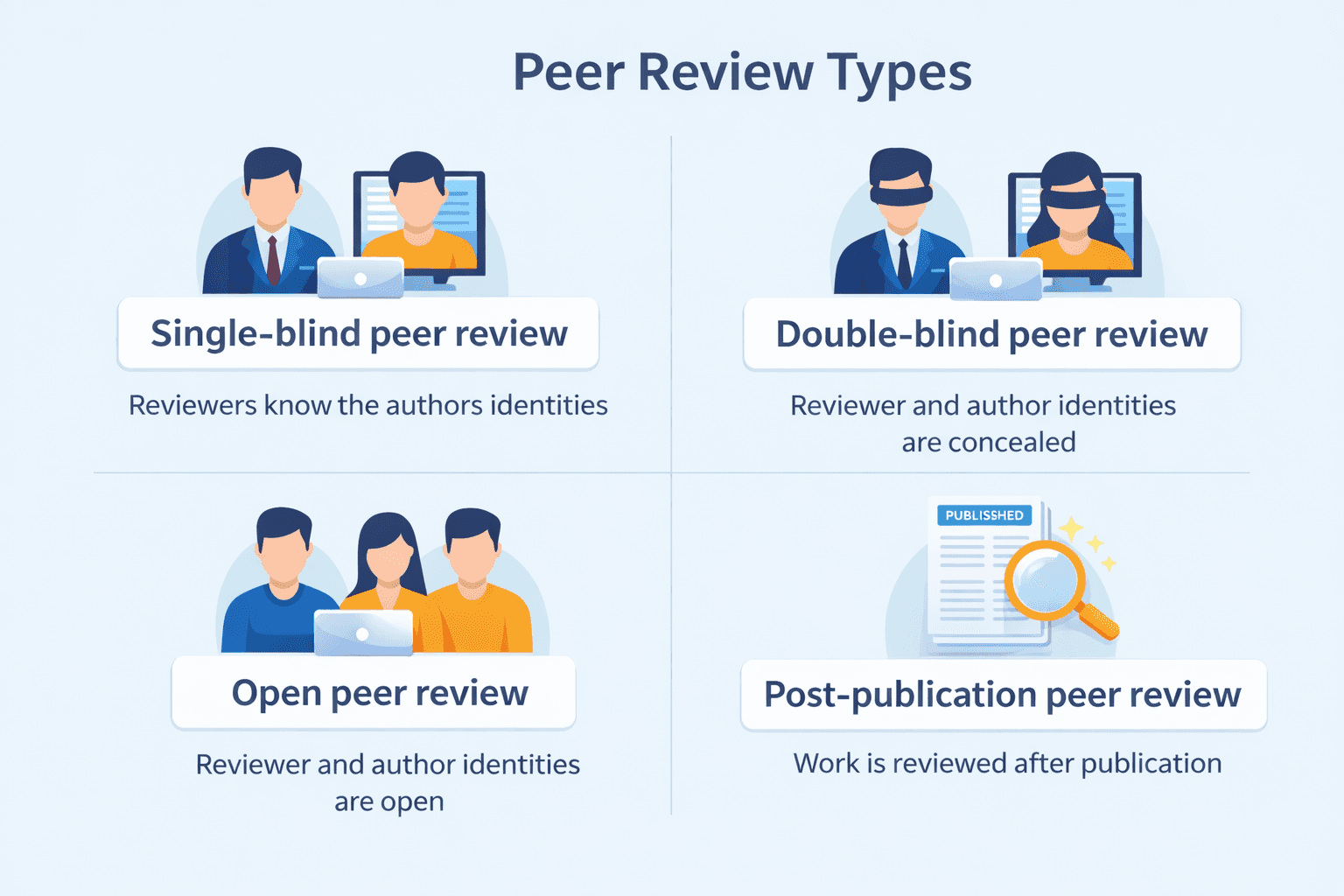
📸 IMAGE: Four types of peer review single blind double blind open and post publication Caption: The four main peer review models used by academic journals in 2026
How Long Does Peer Review Take?
This is one of the most common frustrations in academic publishing. Peer review timelines vary enormously depending on the journal, the field, and reviewer availability. A rough guide:
Fast journals: 4 to 8 weeks from submission to first decision
Average journals: 3 to 6 months
Slow journals: 6 to 18 months or longer
Delays are common. Reviewers are typically unpaid volunteers with their own research commitments, which means they often take longer than the journal's requested deadline. If you have not heard from a journal after three months, it is entirely acceptable to send a polite status inquiry to the editorial office.
What Do Peer Reviewers Actually Look At?
When a reviewer receives a paper, they are typically assessing it across several dimensions:
Significance — does this research address an important question? Does it advance the field?
Originality — is this work novel? Does it add something new to existing knowledge?
Methodology — are the methods appropriate, rigorous, and clearly described? Could another researcher replicate this study?
Results — are the findings clearly presented? Are the statistical analyses appropriate?
Interpretation — do the conclusions follow logically from the results? Are the authors overclaiming?
Presentation — is the paper well written, clearly structured, and within the journal's scope?
Common Outcomes and What They Mean
Accept — rare at first submission. If you receive an outright accept, your paper will be published with minimal or no changes. This happens in fewer than 10% of submissions at most journals.
Minor revisions — the reviewers are broadly satisfied but have specific requests. Respond to every comment directly and clearly. This stage typically takes 2 to 4 weeks of work and usually results in acceptance.
Major revisions — significant changes are required, often including additional experiments, analyses, or restructuring of the manuscript. This is not a rejection. Many excellent papers go through major revisions before acceptance. This stage can take months.
Reject — the paper is not suitable for this journal in its current form. This does not necessarily mean the work is poor — it may simply not be the right fit. Most papers that are eventually published are rejected at least once first.
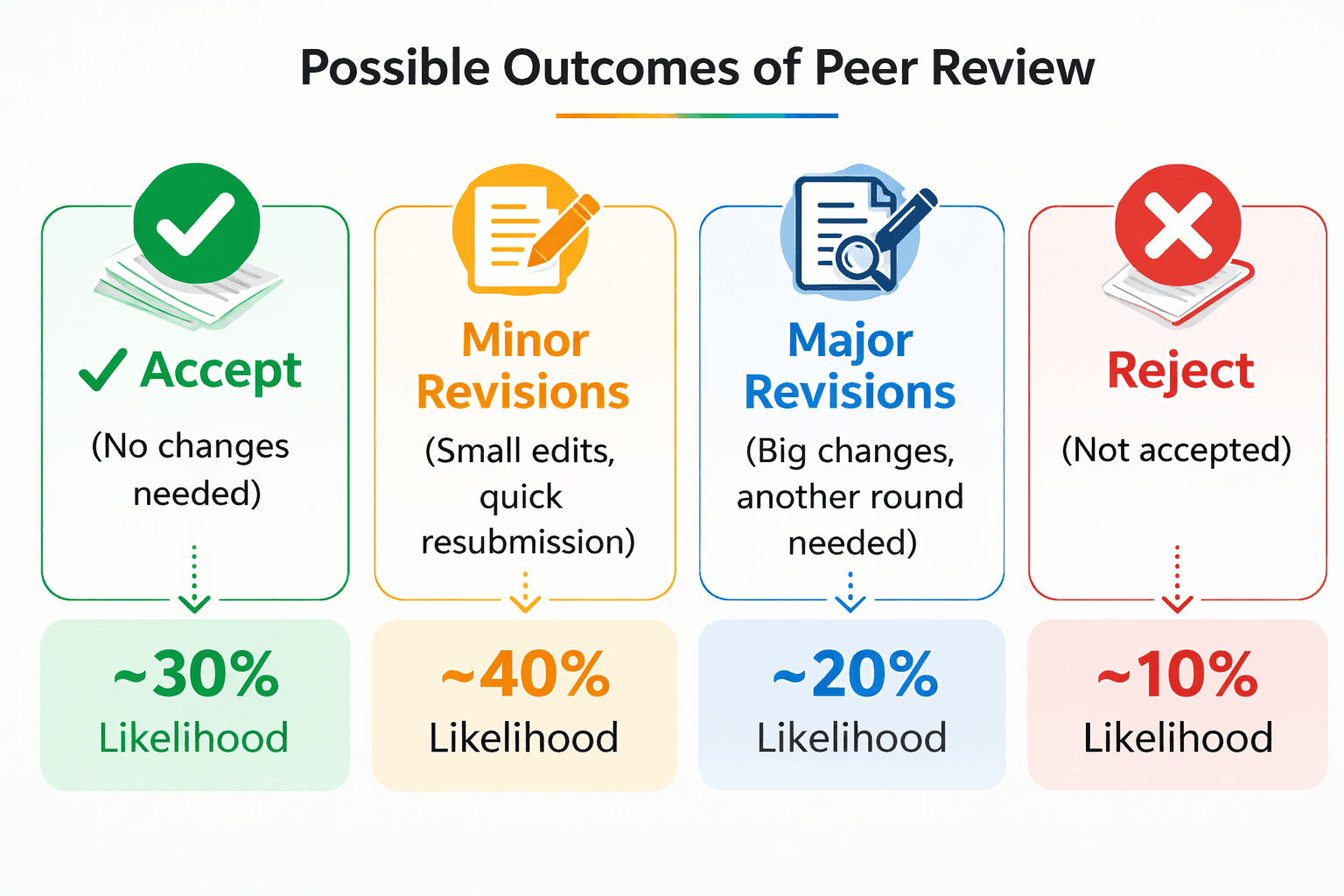
📸 IMAGE: The four possible outcomes of peer review and what each one means for your submission
How to Respond to Peer Review
Receiving reviewer comments for the first time can be a shock — even experienced researchers find it difficult. Here is a framework for responding effectively:
Step 1 — Read and wait. Read the reviews once, then step away for 24 hours before responding. Reviewer comments can feel harsh in the moment but are usually constructive on reflection.
Step 2 — Create a response document. List every reviewer comment and respond to each one individually. Do not skip any comment, even if you disagree.
Step 3 — Be specific. For every change you make, indicate exactly where in the manuscript you made it. For example: "We have added a paragraph on page 6, lines 12 to 18, addressing this concern."
Step 4 — Push back professionally if needed. If you disagree with a reviewer comment, you are allowed to say so — but do so politely and with evidence. Editors respect authors who engage thoughtfully rather than simply complying with everything.
Step 5 — Thank the reviewers. Even if the comments were difficult, begin your response letter by thanking the reviewers for their time. This sets a constructive tone.
Common Criticisms of Peer Review
Peer review is not without its problems. Common criticisms include:
Bias — reviewers may favour work from prestigious institutions or well-known authors, particularly in single-blind systems where author identities are visible.
Slowness — the timeline from submission to publication can take years, which is a significant barrier in fast-moving fields.
Inconsistency — two reviewers of the same paper can reach very different conclusions, raising questions about reliability.
Unpaid labour — reviewers are typically not compensated for their time, which creates sustainability concerns as journal submission volumes grow.
The reproducibility crisis — peer review has not prevented a significant number of published papers from failing to replicate, raising questions about how effectively it screens for methodological problems. You can read more about this in our piece on how AI research tools are changing scientific workflows.
How to Do Your First Peer Review
If you are invited to review a paper for the first time, here is a practical framework:
Read the paper once for overall impression, then a second time taking detailed notes. Structure your review with a brief summary of the paper's main contribution, a list of major concerns that need to be addressed, and a list of minor comments. Be specific, constructive, and respectful. Remember that the authors will read every word you write.
A useful resource is the COPE Ethical Guidelines for Peer Reviewers, which covers the responsibilities and best practices for anyone conducting a peer review for the first time.
If you feel unqualified to review a particular paper, it is entirely appropriate to decline and suggest an alternative reviewer. It is better to decline than to submit a poor review.
FAQ
Is peer review always reliable? Peer review is the best quality control system academic publishing has, but it is not infallible. High-profile retractions demonstrate that peer review can miss fraud, errors, and methodological problems. It is a filter, not a guarantee.
Can I see who reviewed my paper? In most single and double-blind systems, reviewer identities are confidential. In open peer review journals, reviewer names are disclosed. Some reviewers choose to sign their reviews voluntarily even in blind systems.
What is the difference between peer review and editorial review? Editorial review is the initial screening by the journal editor, who checks whether the paper is within scope and meets basic quality thresholds before sending it to peer reviewers. Editorial rejection happens before peer review begins.
How do I find journals to submit to? Identifying the right journal for your paper is an important step. Look at where similar work in your field has been published, check impact factors and scope statements, and use database tools to find journals that match your research area. Platforms like PACR can help you explore the literature in your field to identify where relevant work is being published.
What is predatory peer review? Some journals claim to conduct peer review but do not. These predatory journals charge authors publication fees and publish work with little or no genuine review. Always verify a journal's legitimacy before submitting by checking whether it is indexed in reputable databases like PubMed or DOAJ.
Also see our guide on how to do a systematic literature review and our comparison of PACR vs Academia.edu for a deeper look at research workflows and platform choices.